Landowner and Habitat Programs
Landowner Habitat Programs
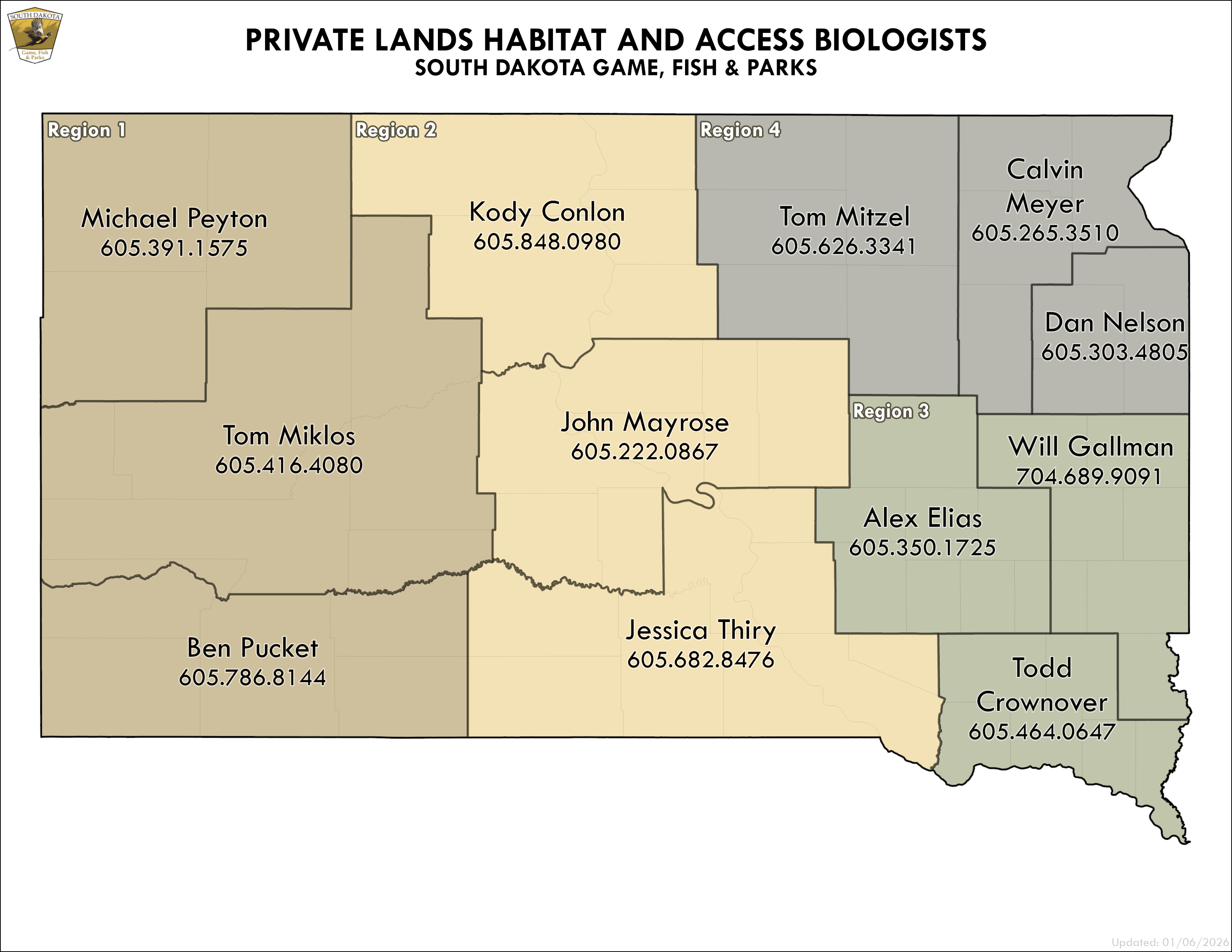
GFP offers cost share to private landowners interested in developing wildlife habitat on their land through multiple habitat programs. Contact one of our Private Land Habitat Biologists to learn more about any of our private land wildlife habitat programs or to evaluate your land and help you develop the best habitat to help you meet your land management goals.
Second Century Working Lands Habitat Program
The Second Century Working Lands Habitat Program provides a short-term, working lands conservation alternative to cropping marginal lands anywhere in South Dakota by adding important grassland habitat for wildlife to the landscape while also providing forage for livestock by allowing program acres to be managed with haying and grazing.
One-time payments are provided to the cooperator in the amounts of $150 (5 yr) or $450/acre(10 yr) for west river counties and $250 (5 yr) or $750/acre (10 yr) for east river counties plus Tripp, Lyman and Gregory counties. Starting during the second growing season, participants can hay or graze the enrolled lands between August 1 and March 1, with annual haying limited to either half the enrolled acres every year, or the entire acreage every other year.
Lands enrolled in the program are not required to be open to unlimited public hunting, although these acres are eligible to be enrolled in the Walk-In Area public hunting access program through GFP. Currently, landowners interested in enrolling their Second Century Working Lands Habitat acres in the Walk-In Area program can receive a one-time, up-front signing bonus of $10 per acre, per year to provide free public hunting access. On top of the signing bonus, they also receive the annual access incentive payments provided through GFP’s Walk-In Area program.
Food Habitat Plot Program
- Free food plot seed is available from GFP each spring (corn, sorghum, brood mix, big game mix).
- Annual payment of $20 per acre for food plot acres ($80 per acre if planted on Walk-In Areas).
- Food plots must remain unharvested through winter.
- Maximum of 20 acres per quarter section.
- Enrollment acres unlimited per landowner.
- Payments are made in February/March.
Woody Habitat Program
Woody habitat is meant to increase wildlife populations by enhancing their survival. GFP has a multitude of woody habitat program options that meet the needs of wildlife. These options include increasing winter survival by installing wildlife shelterbelts, planting shrub clumps to provide browse and cover for deer and upland birds, and managing woodlands and forests to enhance hardwood species establishment and species diversity.
Working Wetland and Grassland Program
In addition to technical assistance, the Wetland & Grassland Habitat Program offers a variety of cost-share options for private landowners to implement conservation practices that benefit wildlife while meeting the needs of working grasslands.
- Wetland Restorations
- Wetland Creations and Enhancements
- Water Development
- Grassland Restorations
- Grassland & Grazing Enhancements
- Riparian Practices
- Wildlife-Friendly Fence
- 105
Grassland Restoration Program
- Provides financial assistance to landowners interested in converting cropland to grassland for grazing and/or wildlife.
- Creates grassland nesting habitat for ground nesting birds like pheasants and ducks.
- Landowners are reimbursed for 100% of the costs incurred for seed.
- One-time payment made upon project completion.
- Cost-share is not available on CRP or WRP plantings.
Perennial Pollinator/Brood Habitat
- Creates high diversity pollinator and brood habitat for a wide diversity of insects and upland bird brood species
- Landowners are reimbursed for 100% of the costs incurred for seed and planting (up to $150/acre).
- 2-9 acres
- One-time payment made upon project completion.
- Cost-share is not available on CRP or WRP plantings.
Habitat Fencing Programs
- Programs protect new or existing habitat from livestock, assist with setting up rotational grazing paddocks, replace woven wire fences with wildlife-friendly fences, etc..
- Landowners are typically reimbursed for 100% of their fencing material costs.
- One-time payment made upon project completion.
Riparian Habitat Enhancement Program
- One-time rental payment for excluding livestock from sensitive riparian areas for 10 years.
- Cost share livestock exclusion fencing and alternative water sources.
- Minimum width of 35 feet and maximum width of 240 feet.
For more information about other habitat programs available through our partners visit the Habitat Resources page of the Habitat Pays website.
Landowner Public Hunting Access Programs
GFP leases public hunting access on private land across the state to maintain South Dakota’s rich hunting heritage through the following programs. Contact our staff in your part of the state to learn more about any of these programs.
Walk-in Area Program (WIA)
The WIA program leases private land with valuable hunting opportunity for unlimited public hunting access (foot-traffic only) in exchange for an annual payment and immunity from non-negligent liability. The Walk-In Area program began in 1988 leasing public hunting access from 26 landowners on 23,161 acres, and has grown to partnering with over 1,400 landowners who provide public hunting access to over 1.2 million acres of private land. A Legislative Commemoration was issued in 2018 commending the South Dakota Game, Fish and Parks and the landowners of South Dakota on 30 years of partnership to provide public hunting access through the Walk-In Area Program. More information.
Cooperative Management Areas (COOP Areas)
Similar to a Walk-In Area, but a COOP allows hunters to drive on harvested cropland for the purposes of placing & retrieving waterfowl decoys. Hunters with a disabled hunting permit are also allowed to drive on these areas to hunt any game. All other access is limited to foot traffic only an no hunting is allowed while farm machinery is present.
Controlled Hunting Access Program (CHAP)
CHAP is a cooperative effort between private landowners and Game, Fish and Parks to provide limited public hunting access on private land Landowners who enroll in CHAP control the amount of hunter use at a given time, set special provisions for use, and place restrictions on game species allowed to be harvested. For more information or assistance, visit the Habitat Pays website.
Conservation Reserve Enhancement Program (C.R.E.P.)
Administered by the USDA's Farm Service Agency and South Dakota Game, Fish and Parks, this program is a "state-sponsored" Conservation Reserve Program providing additional, undisturbed habitat for wildlife that is open to public hunting and fishing access in the James River watershed and the Big Sioux River watershed.
Elk Hunting Access Program (EHAP)
EHAP's purpose is to increase hunter harvest; specifically on private lands with higher than landowner-tolerable elk use. Private land anywhere in the Black Hills elk hunting units will be considered. Access to the property (how many, when, and where) is controlled by the enrolled landowner. This allows the hunting to take place where the best chance of success is, as well as with the best chance to diminish elk depredation. GFP does not sign the boundaries (as with walk-in areas), nor are maps of the enrolled properties made available. GFP provides the contact information for participating landowners upon request. License holders are responsible for making contact with the landowner, and making arrangements to hunt the enrolled property.
Newsletter | Landowners Matter
As a vast majority of South Dakota is privately owned; farmers, ranchers and other private landowners are the principal stewards of wildlife resources and the habitats in which they depend.
The Landowners Matter newsletter is printed and distributed twice a year; April 1 and October 1 and is mailed to approximately 44,000 South Dakota landowners.
Wildlife Damage Management
GFP employs 28 full-time Wildlife Damage Specialists (WDS) within its comprehensive Wildlife Damage Management Program. These staff members work directly with landowners and producers to reduce or alleviate wildlife damage such as: livestock losses, damage to stored-feed supplies and hay, damage to growing crops, and damage to personal property. They are trained to handle all types of wildlife damage, from coyotes to elk. Additionally, they conduct educational programs on sport trapping as a form of recreation and its importance in the management of furbearers. These programs can be presented in classrooms, meeting halls, summer camps, or other group meeting locations.
For more information on the below programs please contact your local Wildlife Damage Specialist.
Wildlife Damage Management Action Plan
The Wildlife Damage Management (WDM) Action Plan was recently adopted by the GFP Commission in March of 2026 after a 60-day public comment. A copy of this action plan can be found here.
Guided by the action plan, the WDM program offers a variety of assistance tools and programs to help mitigate wildlife conflicts. The action plan includes the following four goals: 1) Support landowners in minimizing damage to livestock, crops, and property by delivering practical and responsive wildlife damage management services; 2) Promote strong landowner and stakeholder relations through effective communication; 3) Deliver excellent customer service and maintain program transparency; and 4) Strengthen and expand partnerships with landowners to promote habitat enhancement and increase public hunting access on private lands. Each goal has respective objectives, strategies, and action items.
Prairie Dog Control
GFP will provide direct control of prairie dogs that have encroached onto private property from adjacent public lands. To be eligible, landowners must have a minimum of 10 acres of actual prairie dog colony and must be within one mile of the public land boundary. Tribal property or municipal properties are not considered public lands. If you have questions about prairie dog control from GFP, please call 605.394.2391. Register for the Prairie Control Program.
Additional Practices for Effective Prairie Dog Management
Beaver and Nuisance Animal Control
GFP will provide direct control of beavers for landowners or livestock producers that are experiencing damage caused by beavers. However, for problems with beaver damage inside city limits, people are encouraged to contact their local city officials for these types of requests. GFP only provides technical advice in these situations. For damage caused from raccoon, skunks, mink, and other nuisance wildlife species, GFP will provide technical assistance and may loan live traps to the public. Every situation is unique, and GFP staff working cooperatively with the affected landowner will determine the most effective approach. Contact your local Wildlife Damage Specialist for assistance.
Canada Goose Damage Assistance
GFP has several programs and services available to assist landowners and producers that experience damage to growing-crops from Canada geese. The most popular service is the installation of temporary electric fence around growing soybeans, which serves as an effective barrier to flightless geese during the summer months. GFP also offers up to $5,000 worth of cost-share assistance to producers to plant protective buffer-strips around growing crops, that protect the larger field from Canada goose damage. These buffer-strips may be wheat, alfalfa, or native grasses which create a visual barrier, so the geese are discouraged from entering the crop field. GFP may also provide up to $5,000 of cost-share assistance to construct woven wire fence along the edge of wetlands which prohibits geese access to the crop fields when the birds are flightless. GFP provides direct assistance when Canada geese are causing damage to growing crops or causing other issues on private lands; utilizing tools such as hazing, alternate feeding sites or egg addling. GFP may also authorize the affected landowner a permit which allows the landowner to lethally remove a small number of Canada geese that are causing crop damage. These permits serve as an effective form of hazing and can haze the remaining birds away from the immediate area. Allowing licensed hunters to harvest Canada geese during the August Management Take or Early Fall Canada Goose season is also very effective. Every situation is unique and GFP staff, working cooperatively with the affected landowner, will determine the most effective approach.
Deer Damage Assistance
GFP has several programs and services available to assist landowners and producers with deer damage. GFP offers up to $10,000 worth of cost-share assistance to construct permanent protective stackyards or can provide protective, portable panels or secure covers that protect stored livestock-feeds (e.g., hay, corn, silage, or other stored feed supplies) from deer damage during the winter months. These two programs are very popular and provide long-term solutions. GFP also provides direct assistance when deer are causing damage to growing crops, orchards, and other private property by utilizing hazing, temporary fencing, short-stop baiting, and in some situations, lethal control and/or depredation hunts. Every situation is unique and GFP staff, working cooperatively with the affected landowner will determine the most effective approach.
Elk Damage Assistance
GFP has several programs and services available to assist landowners and producers with elk damage. GFP offers up to $15,000 worth of cost-share assistance to construct permanent protective stackyards or can provide protective, portable panels to protect stored livestock-feeds (e.g., hay, corn, silage) from elk damage during the winter months. These two programs are very popular and provide long-term solutions. GFP also offers up to $15,000 worth of fencing materials and protective cable that when installed correctly can reduce damage to fences from elk crossing them. GFP offers up to $8,000 of cost-share assistance to landowners for growing-season food-plots where landowners have elk feeding on alfalfa fields or other growing crops. Landowners may also be eligible for up to $4,000 of cost-share assistance for hay land contracts. These contracts are for grasslands that are annually hayed by landowners, not grazed by livestock and have elk feeding upon these areas. GFP also provides direct assistance when elk are causing damage to growing crops or causing other issues on private lands by utilizing hazing, temporary fencing, short-stop baiting, and in some situations, lethal control and/or depredation hunts. Every situation is unique and GFP staff, working cooperatively with the affected landowner, will determine the most effective approach.
Predator Control
GFP provides direct control (e.g., trapping, snaring, calling, aerial hunting) of coyotes and red foxes to livestock producers or landowners that request assistance with livestock loss issues or livestock protection requests from predators. GFP operates an aggressive predator control program and works cooperatively with thousands of livestock producers and landowners across South Dakota, to resolve these requests for service. Every situation is unique and GFP staff working cooperatively with the affected landowner will determine the most effective approach. Contact your local Wildlife Damage Specialist for assistance.
Turkey Damage Assistance
GFP has several programs and services available to assist landowners and producers with damage caused from turkeys. The most popular service is the installation of protective netting which is installed on bales of oats, silage, or other small grain bales. GFP also provides direct assistance when turkeys are causing damage or other issues on private lands by utilizing hazing, temporary fencing, and alternate feeding sites and in some situations, lethal control and/or depredation hunts. Allowing licenses hunters, especially during the fall season, to harvest turkeys can be very effective to reduce local turkey populations. Every situation is unique, and GFP staff, working cooperatively with the affected landowner will determine the most effective approach.
One of GFP's primary challenges in wildlife management is working with agriculture producers to minimize the impact that wildlife has on their operations.
There are a number of methods for deterring wildlife from causing damage, including: create alternate feeding sites, temporary and permanent fencing, and hazing wildlife away from an area.
When other methods fail, GFP and private landowners may turn to hunters to help reduce the discourage wildlife causing damage.
South Dakota residents may sign up for a potential depredation hunt in December. If there is a need, a hunt may occur anytime from December through March.
Registration begins December 1, 8 a.m. CST